What We Do
Four application areas define DiPS
Evidence integration and decision frameworks.
Connecting pharmacology, efficacy, safety, welfare, pathology, mechanistic data from non-animal assays, exposure-response, adverse outcome pathways, and clinical intent into decision-ready preclinical evidence packages. Animal-based and non-animal evidence are integrated under the same decision logic.
Context-of-use evidence requirements and regulatory confidence.
Fit-for-purpose evidence logic, auditability, lifecycle management, and regulator-grade templates — applied symmetrically to evidence from animal models, microphysiological systems, organoids, in-silico methods, and hybrid approaches.
Dynamic biological monitoring and novel digital evidence.
Continuous or frequent measurement of biology in animal models (behavior, physiology, disease modulation, exposure-response, adaptive-to-maladaptive transitions) and in non-animal systems (time-resolved imaging, multi-electrode array recordings, organ-on-chip readouts, perfusion dynamics, organoid morphometric and functional change, live-cell mechanistic readouts).
Computational transformation and reuse of existing evidence.
Digital pathology outputs, historical study data, structured metadata, SEND-like efficacy datasets in animal-based work, and equivalent data structures for non-animal methods including the U.S. EPA ToxCast and Tox21 databases, EURL ECVAM databases, the OECD QSAR Toolbox, and emerging data structures for microphysiological systems and organ-on-chip platforms. Study reconstruction and reusable evidence packages span both modalities.
How we work.Three pillars structure DiPS

Codify & Standardize.
We define the field. We publish the body of knowledge — definition, scope, taxonomy, decision contexts, fit-for-purpose evidence requirements, and regulator-grade templates. We do not certify. We set the reference standard for application.
Convene & Collaborate.
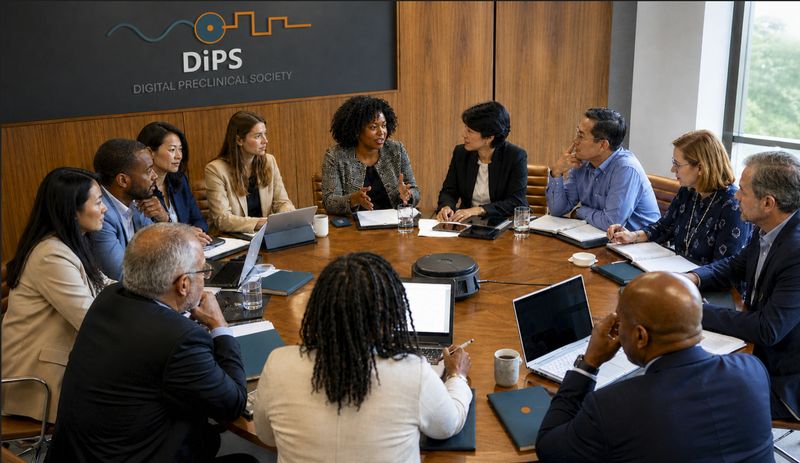
We bring the multi-stakeholder table together and keep it together — scientists, regulators, sponsors, CROs and CDMOs, academia, 3Rs and NAMs communities, digital technology providers, and data standards bodies. We begin with a focused founding forum series.

Translate, Educate & Learn.
We publish open-access resources — handbooks, templates, benchmark datasets, case studies, failure reports, and foundational papers. We surface what fails as readily as what works.
Year one foundation products.
Year one is field-definition, not working groups. DiPS focuses on four foundation products: a definition and scope statement; an opportunity and value proposition map; a founding forum series; and a foundational gaps and opportunities manuscript. Funded working groups begin only when the foundation products show where partner demand and field value are strongest.