Why we exist
Fewer than one in ten drug candidates entering Phase 1 ever reach patients. The cost is counted in failed molecules, delayed therapies, wasted animals, regulator rework — and in patients who run out of time.
Preclinical evidence fails to predict clinical outcomes at rates the industry has normalized as the price of doing business.
And yet the tooling is now sufficient. The stakeholders — regulators included — are aligned on the need for shared standards.
The gap is not technological. It is structural. It sits in endpoints, in metadata, in validation, in regulatory alignment, and in the incentives that shape all four.
What has been missing is not another tool.
A discipline has been missing.
DiPS is that collaboration.
How it works

Preclinical evidence does not predict the clinic.
Endpoints are weak or surrogate. Metadata is incomplete. Validation is inconsistent. Regulatory expectations are ambiguous. The gap is structural, not a matter of any single platform.
Our commitment.
We codify a discipline of fit-for-purpose, regulator-grade preclinical evidence — with shared vocabulary, shared standards, and shared evidentiary criteria legible to the regulators we work with.
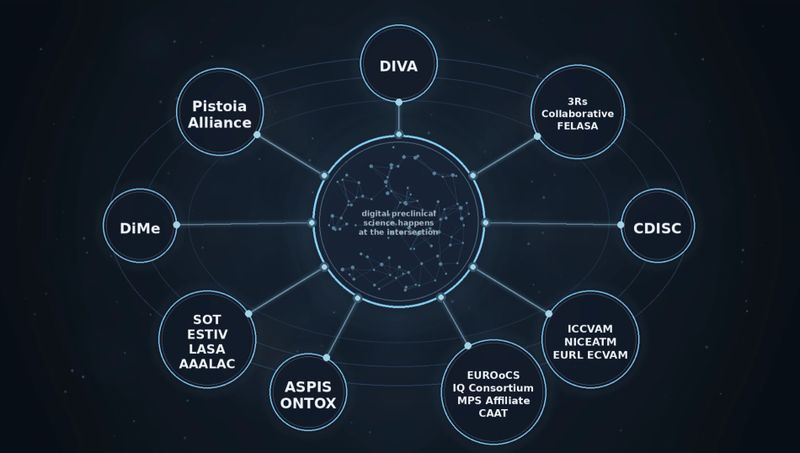
Progress sits in silos.
DiMe is the professional society for digital medicine, driving scientific progress and adoption across digital clinical measures and endpoints, digital health technologies, AI in healthcare, virtual-first care, and connected health. DIVA leads on digital biomarkers. Pistoia Alliance leads on pre-competitive data standards. 3Rs Collaborative , NC3Rs and FELASA lead on replacement, reduction, and refinement. CDISC leads on data standards. ICCVAM, NICEATM, and EURL ECVAM lead on alternative method validation. ASPIS leads on integrated mechanistic frameworks. EUROoCS, the IQ Consortium MPS Affiliate, and CAAT lead on microphysiological systems and broader alternatives science. SOT, ESTIV, LASA, and AAALAC each convene their disciplines. None of them alone owns the intersection where digital preclinical science actually happens.
Our commitment.
We federate — never duplicate. We partner with every one of these bodies. We codify what sits between them.

Ideology has crowded out evidence.
The binary argument between NAMs and animal research consumes energy that belongs to the harder question: is the evidence fit for purpose, and does it predict?
Our commitment.
We take no side in that debate. Both modalities have legitimate uses. Both have failure modes. We evaluate every platform and every modality — digital, in vivo, in vitro, ex vivo, in silico, MPS-based, organoid-based, AOP-derived, AI-enabled — against one standard: context-of-use, fit-for-purpose, predictive of clinically meaningful biology.
What we work on
Evidence integration and decision frameworks.
Connecting pharmacology, efficacy, safety, welfare, pathology, mechanistic data from non-animal assays, exposure-response, adverse outcome pathways, and clinical intent into decision-ready preclinical evidence packages. Animal-based and non-animal evidence are integrated under the same decision logic.
Context-of-use evidence requirements and regulatory confidence.
Fit-for-purpose evidence logic, auditability, lifecycle management, and regulator-grade templates — applied symmetrically to evidence from animal models, microphysiological systems, organoids, in-silico methods, and hybrid approaches.
Dynamic biological monitoring and novel digital evidence.
Continuous or frequent measurement of biology in animal models (behavior, physiology, disease modulation, exposure-response, adaptive-to-maladaptive transitions) and in non-animal systems (time-resolved imaging, multi-electrode array recordings, organ-on-chip readouts, perfusion dynamics, organoid morphometric and functional change, live-cell mechanistic readouts).
Computational transformation and reuse of existing evidence.
Digital pathology outputs, historical study data, structured metadata, SEND-like efficacy datasets in animal-based work, and equivalent data structures for non-animal methods including the U.S. EPA ToxCast and Tox21 databases, EURL ECVAM databases, the OECD QSAR Toolbox, and emerging data structures for microphysiological systems and organ-on-chip platforms. Study reconstruction and reusable evidence packages span both modalities.
What we do

Codify & Standardize.
We define the field. We publish the body of knowledge — definition, scope, taxonomy, decision contexts, fit-for-purpose evidence requirements, and regulator-grade templates. We do not certify. We set the reference standard for application.
Convene & Collaborate.
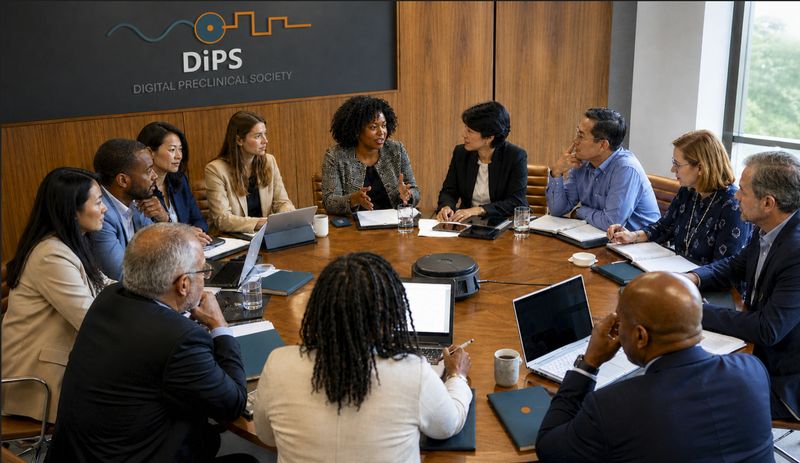
We bring the multi-stakeholder table together and keep it together — scientists, regulators, sponsors, CROs and CDMOs, academia, 3Rs and NAMs communities, digital technology providers, and data standards bodies. We begin with a focused founding forum series.

Translate, Educate & Learn.
We publish open-access resources — handbooks, templates, benchmark datasets, case studies, failure reports, and foundational papers. We surface what fails as readily as what works.
Get Involved
Our founding board Two co-chairs seated. Seven founding seats being filled along two axes: sector (Pharmaceutical & Biotech Companies, Regulatory Agencies, Academic and Contract Research Organizations) and domain (3Rs/NAMs, MPS, computational toxicology, digital technology, data standards). Nominate someone strong on at least one axis.Nominations are open until June 1, 2026.Nominate a Founding Board Member

Stefano Gaburro, PhD
Co-Chair, Industry & Governance (EU)
Europe-based industry scientist and translational digital biology leader, spanning neuropharmacology, preclinical neuroscience, laboratory animal welfare, 24/7 home-cage monitoring, digital biomarkers, minimal metadata standards (Pistoia MNMS Working Group), the integration of animal-based and non-animal modalities, and the application of digital technologies to improve preclinical model relevance and reproducibility.

Szczepan Baran, MS, VMD
Co-Chair, Industry & Governance (US)
Chief Scientific Officer at Instem and founder of Baran Café, spanning digital health, AI, NAMs, translational safety, animal welfare, regulatory science, and data-driven preclinical development.
Our accountability
The success of DiPS will not be measured only by the members we recruit, the meetings we convene, or the papers we publish. Its long-term measure is whether preclinical evidence becomes more reliable, more clinically predictive, more reproducible, more humane, and more useful for regulatory and portfolio decisions. Because that outcome takes years to observe, DiPS holds itself to three near-term lead measures: regulator-proximate outputs; sponsor adoption in active pipelines; federation coverage with documented non-overlap. If these three move, the long measure follows. If they do not, the long measure will not — and we will know early. We invite our members, our partners, and the regulators we work with to hold us to it.
The Digital Record
Frequently Asked Questions about the DiPS Digital Preclinical Society
What is the DiPS ?
DiPS — the Digital Preclinical Society — is the first professional society that aims to collaboratively leverage the power of digital capabilities. We are a member-based, multi-stakeholder, cross-Atlantic body. Together, we convene scientists, regulators, sponsors, CROs, and technology providers around one question: does the evidence predict the clinic? We federate. We codify. We convene. Where others lead, we reinforce. Where the field lacks a bridge, we build it.
How can I benefit from joining DiPS?
You do not join DiPS for access. You join to build the discipline.
As a member, you shape the standards that sponsors, CROs, and regulators will use across digital preclinical science. You sit in working groups alongside FDA, EMA, ICH, OECD, and PMDA participants — we draft our standards with regulators in the room, not to them after the fact. You read, challenge, and co-author the consensus outputs — handbooks, templates, benchmark datasets, case studies — before they enter the wider field.
Founding members do more. The founding board and the charter signatories set the terms for everything that follows. Founding seats close once the founding board is seated.
One caveat — we are a Society, not a vendor. We do not sell productivity. We build the discipline you will practice in.
How do I get started with DiPS?
Start with the charter. Read it. If the argument holds, sign it. Then pick your on-ramp — seven exist, one will fit you:
- Scientist at the preclinical-to-clinical interface. Sign the charter. Join the founding forum series.
- Leader of preclinical safety, toxicology, pharmacology, efficacy, or translational research at a pharma or biotech. Join the founding partner circle.
- CRO, CDMO, vivarium technology organization, data standards body, or digital platform company. Bring a use case, not a product pitch.
- Regulator — FDA, EMA, ICH, OECD, PMDA, or another public authority. Participate as a regulator-member, free of charge.
- Adjacent organization — DIVA, Pistoia Alliance, 3Rs Collaborative, DiMe, FELASA, CDISC, or a discipline-specific society. Open a partnership pathway or memorandum of understanding.
- None of the above, but you care about preclinical evidence reaching patients reliably. Attend the founding forum series.
- You want the discipline delivered to you weekly. Subscribe to The Digital Record.
What kind of collaboration opportunities does DiPS facilitate?
Year one is field-definition, not working groups. DiPS focuses on four foundation products: a definition and scope statement; an opportunity and value proposition map; a founding forum series; and a foundational gaps and opportunities manuscript. Funded working groups begin only when the foundation products show where partner demand and field value are strongest. The founding forum series is the first table — aligned presenters, moderated roundtables, practical reading sessions. Regulators participate free of charge where agency rules permit. We draft with regulators in the room, not to them after the fact. We federate with adjacent organizations on both the in-vivo and the non-animal sides — DIVA, Pistoia Alliance, 3Rs Collaborative, DiMe, FELASA, CDISC, ICCVAM, NICEATM, EURL ECVAM, ASPIS, ONTOX, EUROoCS, the IQ Consortium MPS Affiliate, CAAT, and discipline-specific societies — through partnership pathways, not competition. Memoranda of understanding, not silos.
How does DiPS keep members at the front of the field?
Members do not consume the field. They build it. Together, we codify the standards, draft the templates, and shape the consensus outputs that the field then adopts. The Digital Record — our weekly publication — tracks what we published, what we partnered on, what we learned, and what we changed our minds about. Three on-ramps, one direction: in front of the field because you helped define it.
Get In Touch With DiPS
DiPS is being established as a U.S. 501(c)(6) membership organization
and a German e.V. Not yet incorporated.
Kendall Square · Cambridge, MA 02142
857-799-3969 · info@dipsociety.org